How to Win the IT Talent War
Table of contents
The word war isn’t inspiring or interesting. But I couldn’t find another word that so faithfully and simply captures what happens every single day inside organizations. There’s an open war to find and retain IT talent. IT talent — information and communications technology talent — is today an extremely valuable and critical asset for nearly every organization in the world. Even more so for organizations whose operations depend entirely, or largely, on IT.
The coronavirus pandemic caused an unprecedented transformation across organizations worldwide. The adoption of technology tools and the digitization of businesses and work processes are some of the results of that transformation. And none of it could exist without the support of IT talent.
According to ManpowerGroup’s 2026 Global Talent Shortage Survey — more than 39,000 employers across 41 countries, with fieldwork done in October 2025 — 72% of employers still can’t find the qualified talent they need. We’re nowhere near the end of this war. So here are some thoughts on this “war” and recommendations on how to win it - to attract and retain the best IT talent.
Demand for IT Talent
The first thing you need to understand is why there’s a war for IT talent, and how it affects turnover on your team or in your company.
The Shortage of Qualified IT Talent
Back in 2018 and 2019, before the pandemic, the shortage of qualified talent was already the number one emerging risk for organizations globally, according to surveys from that time. The pandemic that followed didn’t invent the problem - it just accelerated it dramatically: schools, universities, government agencies, and companies of every size had to digitize overnight, and everyone needed the same scarce talent at the same time.
AI Changed Which Talent Is Scarce
What’s changed since then isn’t that the shortage disappeared - it’s still there, almost untouched - but which kind of talent is scarcest. According to ManpowerGroup’s 2026 Global Talent Shortage Survey , for the first time, building AI models and applications (20%) and AI literacy (19%) are the hardest capabilities to find in the world - ahead of traditional engineering, which for years was the gold standard of scarcity. Traditional IT and data skills now rank a distant seventh.
McKinsey reports that demand for “AI fluency” - the ability to use and manage AI tools, not just code with them - grew almost 7x in two years, and now shows up in job postings employing close to 7 million people in the US alone. And we’re not just talking about programmers: AI fluency is now being asked for in management, finance, marketing, and education roles.
A New World View Brings New Priorities
The post-pandemic wave of mass resignations (the so-called “Great Resignation”) has passed, but it left a mark: it deeply shifted the wants, dreams, and aspirations of a lot of people. Employees want to invest more in the more human sides of work. Human connection, feeling valued, and feeling like an important part of something bigger matters a great deal to many people - and, interestingly, this shows up in the very same 2026 data: communication and teamwork (38%) and adaptability and willingness to learn (35%) now top the list of hardest-to-find soft skills. Technical talent alone isn’t enough anymore.
The Difficulty of Finding Qualified Talent
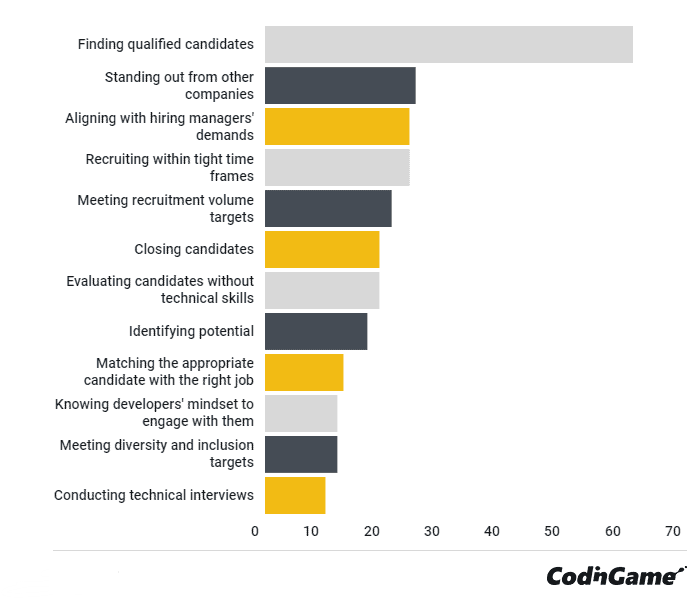
“What are your main challenges when recruiting developers?” CodinGame 2021 - a snapshot of a problem that, five years later, has only gotten deeper.
That 2021 survey was one of the first to put hard numbers on the problem. Today, the 2026 ManpowerGroup survey confirms the difficulty was never solved: 72% of employers globally still can’t find the qualified talent they need, barely two points down from the year before. With fresh data in hand, finding qualified candidates remains the number one challenge for recruiting teams.
The Cost of IT Talent Turnover
While demand keeps climbing, there’s a dark side to this war: the cost of losing part of your IT team. IT talent isn’t just hard to find - as I mentioned before - it also takes a lot of time to learn the organization’s dynamics, its technology products, and the business quirks that make the IT function so particular.
It’s not just about knowing a programming language, or how to operate a system. It’s also about understanding how product X or Y serves the organization’s business, and the people within the organization and their roles in making “the magic happen.”
That magic is what we formally call “delivery.” No single person makes up an IT department, and no one can run a bank or a school on their own. Understanding organizational dynamics and how information systems relate to the business - or to business processes - is key to the success of an IT department and its team.
So when you lose a developer, or a security expert, you don’t just lose their specific technical knowledge - you also lose someone capable of interacting with the organization, understanding requirements beyond the documentation, or even solving problems that aren’t obvious. Has this happened to you?
Recommendations for Winning the War for IT Talent
I’m going to split these recommendations into two big groups: a) what we can do in our organizations and teams to “attract talent,” and b) what we can do to keep the people who already work with us from deciding to leave.
This list isn’t perfect - it’s a mix of general knowledge (and popular recommendations) and my own personal experience.
Attracting IT Talent
The first thing you need to understand is that you’re not the only one looking for people. IT talent generally gets several offers a week from other companies. And if they’re talented, I can assure you those are attractive offers, backed by very persistent, excellent negotiators.
So before we get into the recommendations, you need to clearly answer this question: why should someone who already has a job, and multiple offers, work at your organization or on your team?
With that question in mind, now you need to think about what people with IT skills are actually looking for.
1. Technical Challenges and Interesting Problems to Solve
IT talent loves a challenge. People who’ve dedicated their lives to code, servers, security, or wiring things up - as some of my closer relatives would put it - are motivated by learning and growing their skills.
And it’s no wonder: in this profession, if you stop reading the news or learning new things, within 3 to 5 years you’re obsolete.
Everyday Problems Aren’t Always Challenges
Technical challenges aren’t necessarily horrible problems that need an immediate fix - in my country we call them chicharrones, and in other countries they’re known as pedos or quilombos. While IT work tends to come with its share of “unexpected problems that need an immediate fix,” the job on offer can’t be a “firefighter” role - that is, someone whose job is jumping from fire to fire, putting them out. That creates wear and frustration over the medium and long term, not to mention burnout.
2. Flexible Hours, Remote Work, and Work-Life Balance
I don’t think there’s much to explain here. IT work can be done, all or almost all of it, remotely. In my own experience, I’ve worked 100% remote for the last 4 years, and semi-in-person (2 or 3 days a week in the office) for more than 10 years, and I can assure you remote work isn’t necessarily a blessing. It takes discipline and consistency. It can demotivate some people, or even cause depression from a lack of social interaction and connection. I’d invite you to read this article on remote work .
If you want to attract talent and can offer the benefits of remote work, let me give you a few pieces of advice. Remote work has its advantages, but also plenty of downsides, and you can make the most of both.
The Challenge of Flexible Hours and Remote Work
Working remotely sounds wonderful if you’re in front of a computer all day. But the truth is that human beings - most of us, anyway - build personal relationships and bonding mainly by regularly showing up at the office and interacting with other people face to face.
In another article about managing remote teams , I share a few tricks.
A lot of people in IT are introverted or socially distant. While that’s a stereotype, the truth is that spending 8, 10, or 12 hours in front of a computer screen doesn’t make you more sociable. Which brings me to the next point.
3. Build Memorable Experiences
You can offer remote work, or the option to work from home several days a week. But people will only want to work at your organization if there’s “something to share.” Your organization can’t be limited to just the work - there needs to be an extended experience that fosters a sense of belonging.
Years ago I joined a large software development company. We were about 40 people - I could swear I was employee #39. In a conversation with the person in charge of recruiting, we talked about how hard it was to find candidates. That was about 10 years ago now. At the time, I told this person, you need to stop knocking on their door and start building a place where they come knocking on ours.
So you need to sell your company as a real personal and professional experience. You need to make people want to come in, instead of having to go drag them in. That company from the story now grows at a terrifying pace (300 to 400 people a month , or so they say, and my experience tells me that wouldn’t be strange at all).
Think about it again: why would someone invite another person to join the company? What would catch my attention on social media, or through friends of friends? Here are a few examples:
- The chance to work from different offices or cities where the company has a presence
- Annual, biannual, or quarterly events that grab your candidates’ attention - social volunteering, exchanges, challenges, or hackathons
- Intrapreneurship and spin-offs
- The option to work from other cities through partnerships with hotels or “hotel/offices”
4. Salary and Compensation
For me, salary isn’t the measure of job satisfaction or happiness. Otherwise I’d never have left good positions at good companies. Still, a bad salary, out of step with the market, has no excuse.
If your company struggles to keep compensation competitive, I can assure you a smaller, well-paid IT team beats a large team of underpaid people, with high turnover and quality problems in their deliverables.
I recently wrote an article about salary, and how salary and compensation are structured, that can help you better understand different compensation models.
Retaining IT Talent
I could write for days about attracting IT talent, but it’s time to talk about how to retain it. So here are a few tips I hope you’ll find useful.
1. Let Them Do Their Job
Another thing to consider for retaining talent is letting people propose their own solutions and take on their own challenges. In a lot of cases - more than I’d like to admit, and I’m sure the same goes for a lot of my friends and colleagues - you take a new job only to discover your hands are tied, and that any innovative - and risky - solution is going to get shot down by default.
Years ago I was talking with a brilliant woman who was my boss at the time, and I asked her: what’s the point of bringing in such highly qualified people if, in the end, we’re just here to do what we’re told? I told her that in that case, it’d be more cost-effective to bring in less qualified people, assign them repetitive tasks, and only keep a handful of experts telling them what to do. That story is a lot more complex and layered than that, but the takeaway is clear: if you bring in good people, let them do their job.
2. Commit to Building a Great Team
This isn’t just a recruiting pitch. IT talent loves working with good people - having a personal challenge every day. While it’s impossible to have a team full of “superstars,” that doesn’t mean your team can’t still be challenging, or that, through activities beyond the work itself, your organization’s IT talent can’t connect with other role models.
Ongoing Training in Technical Skills and New Tools
Offering IT professionals and talent courses and continuous learning - with tools like Udemy or similar ones - is useful, and shows your genuine, real interest in building a great team.
Helping people build their own path and strengthen their skills is key. And I can assure you your teams and colleagues will talk about it with others.
A lot of organizations offer professional development programs or courses, but few give people the time and space to actually make use of them. What’s the point of 1,000 courses if you can’t attend the sessions, and there’s never any quality time set aside to actually learn?
3. Beyond a Job, You’re Offering a Team
From the outside, a lot of companies look like wonderful places to work. And there surely are wonderful companies where people feel motivated and energized - companies where the members’ attitude makes the environment, or “organizational culture,” foster productivity, good vibes, and that elusive thing called job satisfaction.
But a great company and a great team aren’t necessarily the same thing. You can be part of a great company, on a terrible team, or you can be part of a company with no shine to it, but belong to a great team.
Your perception of the job, and, as a result, your level of commitment and motivation, are a direct reflection of the dynamic of the team closest to you. It’s common to hear that people don’t quit their jobs, they quit their bosses. Organizations are only as good as the team you’re actually a part of.
Not even the best company in the world is exempt from this dynamic. That’s why you need to invest in making sure your IT directors and managers aren’t just technical people with more experience than everyone else. You need to invest in their leadership and communication skills. Strengthening middle management will surely make a difference in how your IT talent perceives the organization.
Directly support team building, team spirit, and teamwork. Beyond the talking points, let people actually live the experience. Can you remember a time you worked on a great team? What do you think matters more - the experience of working for a great company, or of working on a great team? It might sound like a trick question, but the team is “the company’s representation” in employees’ day-to-day lives. That’s the best-kept secret of startups - otherwise nobody would want to work at one.
4. The Organization Isn’t a Family, But You Spend a Lot of Time With Your Team
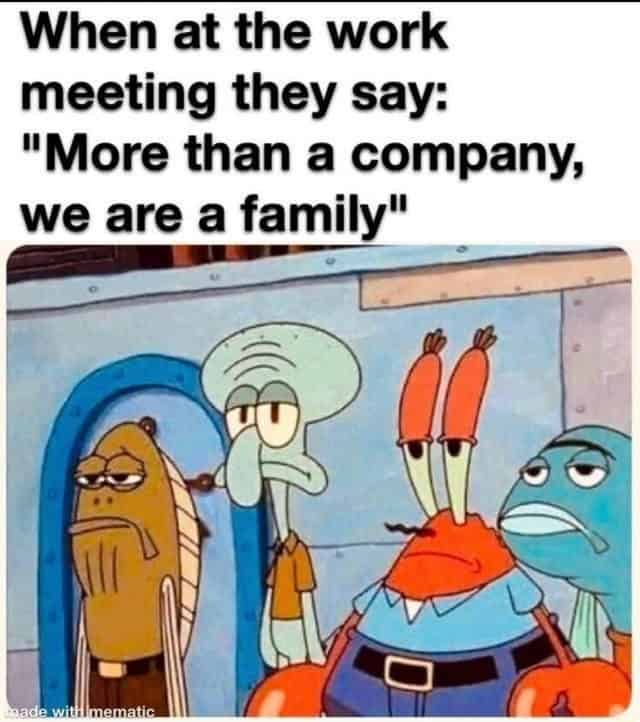
Who hasn’t heard this line: we’re more than a company, we’re a family. Really? To be honest, more than once I’ve been genuinely committed to the organization I work for. And I don’t mean putting in more hours. I mean being one of the people who promote the company, help sell to new clients and land new projects, who gets passionate talking about the workplace and the perks of being part of it. A true believer.
Anyone who’s worked with me at one of those companies knows I don’t just invite people to join the team - I talk about the company all the time and help bring more people in.
But, as Achbar and Abbott lay out well in their documentary “The Corporation,” companies have no sense of ethics or memory. They feel no pain or sadness over a colleague leaving. Companies use you for as long as they need you, and they will never, ever, ever offer you a job just to help you out. If you disagree with that, you’re wrong. If you sense commitment and humanity somewhere, that’s not the company doing it, or its balance sheets, or its stock - that’s people, human beings making everyday decisions inside the company.
That’s how I learned to love my teams, to work with and for them. My people. A lot of them are my friends today. I know it’s impossible for everyone to like me, and I’m sure there’s more than one person who doesn’t - for reasons I honestly don’t know - but that doesn’t mean I don’t enjoy spending time with my team. Through the good and the bad. Projects aren’t all sunshine, but the team’s attitude really does make the difference.
So if the organization or company isn’t your family, your team is the closest thing that comes to competing with your family. Good teams, good “work families.”
5. Talk to Them, Find Out What They Need
A key part of any strategy to reduce IT talent leaving your organization is knowing what they need - which isn’t always the same as what they want. It’s not always about compensation. It’s almost always about the connection between your people and their directors, coordinators, or managers. Feeling valued and feeling like they belong.
I’ve written this before, more than once. A good salary and benefits are more than desirable, but they don’t guarantee you’ll want to stay forever. If they did, nobody would ever quit “the companies everyone dreams of working for.”
A Battle That Never Ends
One thing is clear: this war is far from over. And it forces everyone - not just people working in HR or recruiting - to rethink how we work, lead, and organize work itself.