What Is Kanban and How Does It Relate to Agility?
Table of contents
If you talk about agility with anyone, or even just use an “agile” work management tool, you’ll keep running into the term Kanban. Kanban is a method that was born under a work and manufacturing process management model called the Toyota Production System (TPS) .
What Is the Toyota Production System?
TPS is a production system based on the philosophy of achieving the complete elimination of all waste in pursuit of the most efficient methods. Toyota’s vehicle production system is sometimes called the “just-in-time” (JIT) production system, and it’s become very well known and studied worldwide.
This production control system was built on many years of continuous improvement, aimed at manufacturing the vehicles sold to customers as quickly and efficiently as possible. The Toyota Production System (TPS) was built on two concepts: “jidoka” (loosely translated as “automation with a human touch”), since when a problem occurs, the team stops immediately, preventing defective products from being made; and the “just-in-time” concept, where each process only produces what the next one needs, in a continuous flow.
Building on the core philosophies of jidoka and JIT, TPS can efficiently and quickly produce good-quality vehicles, one at a time, that fully meet customer requirements.
Kanban and TPS
Taiichi Ohno was a Japanese engineer considered the father of TPS. He joined Toyota in 1932, and by 1943 he’d been made a supervisor. In the course of his work, he developed JIT and the “seven wastes,” which form the foundation of Lean Manufacturing .
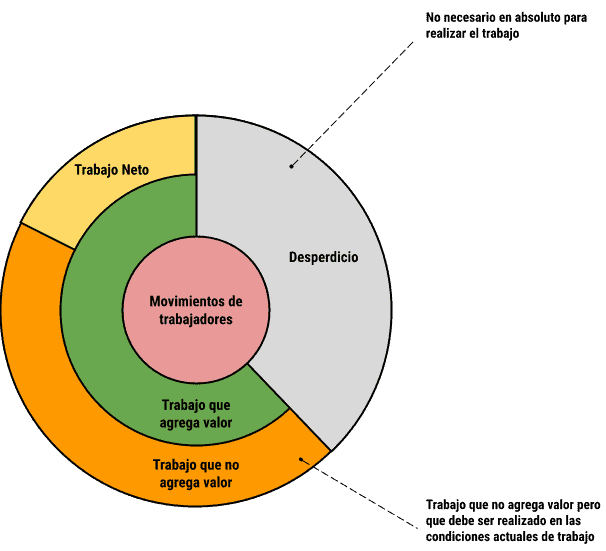
My own version, adapted from the original drawing in Toyota Production System: Beyond Large-Scale Production
The Seven Wastes of Lean Manufacturing
In his book Toyota Production System: Beyond Large-Scale Production, Ohno describes the seven types of waste:
- Overproduction, producing more than what’s needed
- Waiting time
- Transport, moving material and byproducts
- Excessive processing time - that adds no value
- Inventory
- Motion - activities that add no value within a production line
- Defective development of parts or products
Cards: Why Visualizing Workflow Matters in Kanban
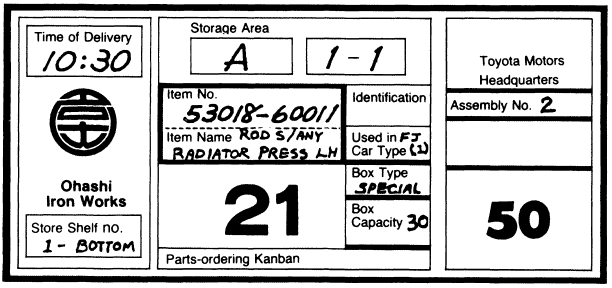
Source: Toyota Production System: Beyond Large-Scale Production - Taiichi Ohno
The ultimate goal of TPS and JIT is to improve workflow - from request to delivery of the result. So how do you keep track of work in a simple way, in an era before today’s ubiquitous computing? That’s where a system for visualizing work through cards emerges - pieces of paper carrying information about the process underway - which, arranged a particular way in a space (now known as a board), gives a sense of the “current state.”
The operating system of TPS is Kanban. Its most common form of use is a piece of paper inside a vinyl sleeve. This piece of paper contains information that can be divided into three categories: (1) pickup information, (2) transfer information, and (3) production information…
Taiichi Ohno, Toyota Production System: Beyond Large-Scale Production
Kanban Is the Operating System of Lean Manufacturing
I love this definition, because Kanban is nothing more than the systematization of information flow - systematization before computing existed. Which means that, in essence, Kanban is the representation of a workflow - preferably one optimized under Lean thinking.
Kanban, Agility, and Scrum
But why is Kanban so important to agility? Here’s why.
Kanban Is a Simple Communication System
If Kanban was designed before the era of ubiquitous computing, and was still hugely successful, why wouldn’t it work now, when so much of the agile world promotes values similar to those of Lean manufacturing?
While Kanban and Lean aren’t “agile,” agile thinking is a direct descendant of Lean - which might ruffle some feathers, but academically speaking, they share a lot of similarities.
If Scrum promotes working in small groups - teams - then simplifying communication and coordination becomes possible without much effort or bureaucracy with Kanban.
Kanban Promotes Fine-Tuning and Continuous Improvement
Visualizing work - that is, simply and quickly answering the question where are we as a team? - also makes it possible to spot bottlenecks or bad practices in how activities are assigned or handed off along the flow.
Just by looking at the board, you can tell whether you have too many tasks started (in progress), or whether, say, one person is carrying more load than another. You can pinpoint steps in the flow that represent a bottleneck, or whether you need to restructure the team’s responsibilities. This is how Kanban promotes process analysis.
Kanban Plays Well with Scrum
Kanban’s rise is, in part, thanks to Scrum’s rise - at least within the agile world. If Kanban is a simple, effective way to see the flow, Scrum’s iterations (Sprints) make it even more useful. Here are a few reasons Scrum and Kanban get along so well.
The Sprint Backlog Simplifies Building the Board
The Sprint backlog limits the “work to do,” or “to do.” The goal of the Sprint’s work plan is, in part, to complete as many tasks as possible that contribute to meeting the Sprint goal. Building a Kanban board for a Scrum team is straightforward for a single Sprint.
The Daily Scrum Flows Better with a Board
Having information about assignments and the status of tasks and work is very useful for improving how the daily meeting flows.
Charts Are Easier to Build with Kanban
It’s not just easier to create a burndown, burnup, or CFD chart - it’s also easier to understand what it means once you have a board. While the board communicates where your team stands, the charts help you understand “how” your team is doing. A good combination will help keep your team more aligned.
The 4 Core Principles of Kanban
Start with What You Do Right Now
To use Kanban, you shouldn’t change your work - your process. Kanban invites you to lay the system over your current process, in order to find opportunities for improvement.
Agree to Pursue Small, Incremental, Evolutionary Improvements
Kanban is useful for spotting bottlenecks and the decisions baked into how work processes are defined that affect efficiency and flow - how much benefit or business value comes out of the system. So identifying small changes and rolling them in (fine-tuning) will help you improve without much resistance.
Initially, Respect Current Roles, Responsibilities, and Titles
The “Kanban” tool will help you evolve over time. That doesn’t mean you should start from the assumption that everything that already exists is wrong. Kanban takes a respectful approach to the current organizational structure and, through small evolutionary improvements, moves things forward from there.
Encourage Acts of Leadership at Every Level
While leadership is traditionally expected to happen at the highest positions in an organization - or at least that’s what a lot of people in traditional organizations assume - Kanban promotes the idea that ideas and actions can emerge anywhere, from anyone. Leadership is a position or role you take on in a given circumstance, not something tied to a title. Kanban knows this, and promotes leadership at every level.
Steps to Implement Kanban
Implementing Kanban with your team is a simple process. Just follow these steps:
Agree with Your Team to Use Kanban
Kanban makes work and assignments transparent. This improves tracking. Does everyone on your team want to be transparent? There are circumstances and organizations where this simple idea might not land well. So before you start, check in with the team and define working agreements.
Identify the Workflow Together
Now that everyone on the team is on the same page, it’s time to identify the current workflow. What are the steps - at a general level - that need to happen to complete the work assigned to the team?
Be pragmatic about this - it’s not about mapping out every single step and exception path in the flow. The idea is to find a way to categorize the state of a team’s assignment or task. If it gets too complex, remember you can always fall back on the simplest three-column model.
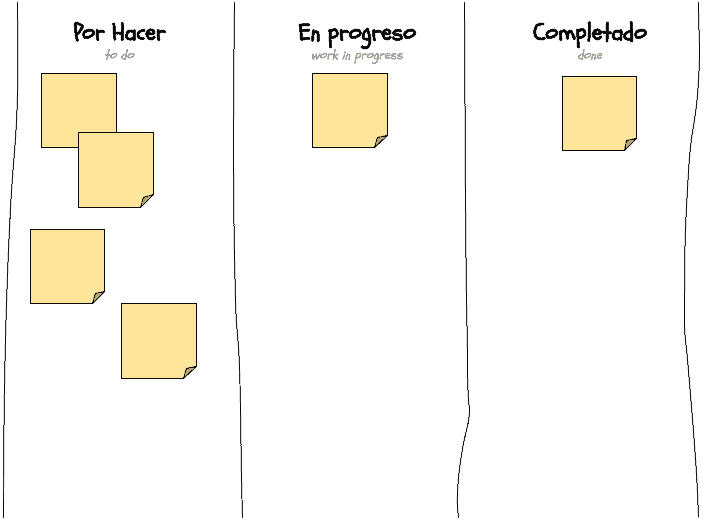
Keep It Simple, At Least at First
Personally, I favor keeping things as simple as possible. That said, some teams feel comfortable including a lot of information or detail on their boards. That’s fine - just make sure that, no matter the level of detail, the team keeps the board up to date, and finds it useful to do so.
Discuss Methodology Findings with the Team Regularly
Now you have clarity on the flow. Discuss regularly - once a month, say - whether you’re spotting bottlenecks or steps in the flow that could be added or removed. Are cards piling up in one column? Are we scheduling too many tasks in the to-do column? How often should we clear out or remove cards from the done column? How often should we add new cards?
It’s all up to the team’s judgment. Of course, if you’re working under the Scrum model, some of those questions already have an answer.
Include Metrics and Charts That Help the Team Dig Deeper
Avoid measuring just for the sake of measuring. Measure what matters and adds value for the team. Cycle time or time invested, defect rate, a burnup or burndown chart, or a CFD can all help improve how the team is managed - and even better if the team is self-organized!
Use the Simplest, Most Powerful Tool
While there are thousands of tools on the market, pick one that’s simple to use, appealing to your team, and lets you grow alongside them. If the team wants to make the process more complex, add more information, or even use the board as a mechanism for managing requirements or a backlog, the tool should be an enabler, not a problem.
I hope you’ve learned about Kanban, and that this article helps you take your first solid steps in adopting one of the most popular practices in the “agile world.”