Leaders and Bosses - The Battle That Never Was
Table of contents
Let’s get straight to the point: even though social media loves comparisons between leaders and bosses, the truth is they’re pure garbage. Leadership is one thing, and being a boss is another. You can be a leader without being a boss, a boss without being a leader, both, or neither. So let’s cut the nonsense and look at why comparing them is like comparing tropical pears to artificial turf.
Leaders and Leadership
By definition, leadership exists because there are one or more followers. Leaders only exist if there are followers. There’s no such thing as a born leader without followers. Leadership is situational - it happens within a particular context that offers an opportunity to lead.
In other words, the leader emerges naturally, or is imposed, in a specific situation. For example, if a group of people finds itself facing risk or a challenge, one or several members are likely to step into leadership positions.
In the tech world, for example, there’s a lot of talk about leaders and bosses. We often see similar or equivalent titles like tech lead, area manager, or project or product director. We attach different qualities to specific roles where we expect leadership to be exercised.
But what does it actually mean to lead?
Defining Leadership
According to the Royal Spanish Academy , leadership is 1) the condition of being a leader; 2) the exercise of a leader’s activities; and 3) a position of superiority held by an institution, organization, product, or economic sector, within its field.
That definition doesn’t help much. So let’s move on to more interesting definitions, away from the dictionary.
McKinsey published an article in 2022 titled What Is Leadership? , defining leadership as a set of behaviors used to help people align their collective direction, execute strategic plans, and continually renew an organization.
Peter Drucker, of whom I admit I’m not a big fan, says that the only valid definition of a leader is someone who has followers. However, in an article by Kevin Kruse - author of the book Great Leaders Have No Rules - he calls this definition dangerously simplistic. I happen to like that much simplicity, and so, apparently, does John Maxwell. The latter says that leadership is influence - nothing more, nothing less.
In short, without getting into romantic visions of leadership, leading is tied to the capacity to influence others, who act as followers.
The Boss, the Villain of the Story

The boss, meanwhile, is tied to a position. A boss is, by definition, someone who holds a rank or role above another person in the same hierarchical line. In other words, the boss has, by organizational structure or policy, the authority to instruct or command their subordinates - or the people who report to them.
Does that power make a person good or bad? Is the boss always the villain of the story? Surely not.
Titles and Roles
If you were paying attention, they’re not the same. Camila and Laura could be coworkers, with the exact same skills and abilities, and one could be the other’s boss. Why? For many reasons - maybe Camila is better at selling her skills in an interview. Maybe Laura is better at conversation and less nervous in interviews, which projects more confidence. Who knows? Maybe the person conducting the interview simply connected better with one than the other. At the end of the day, we’re human, susceptible and variable.
For the purposes of this article, why some people end up as bosses and others don’t is irrelevant.
Still, to round out the idea, here’s another example - one with no dependence at all on individual ability. Imagine someone who just had a baby. This person is very well qualified for a “boss” role. They have the experience, the credentials, and the references. And yet, they decide to take a lower-responsibility position, to make sure that by “following instructions” they take on fewer responsibilities and have more free time - or at least, can disconnect from work once they get home.
You may like this last example or not, but the person in the boss role isn’t always the best suited for it. We just need to understand that the person higher up in the organizational hierarchy will answer for those below them - always, without exception. That doesn’t make them better or worse, just different.
The Good and the Bad, Leaders and Bosses
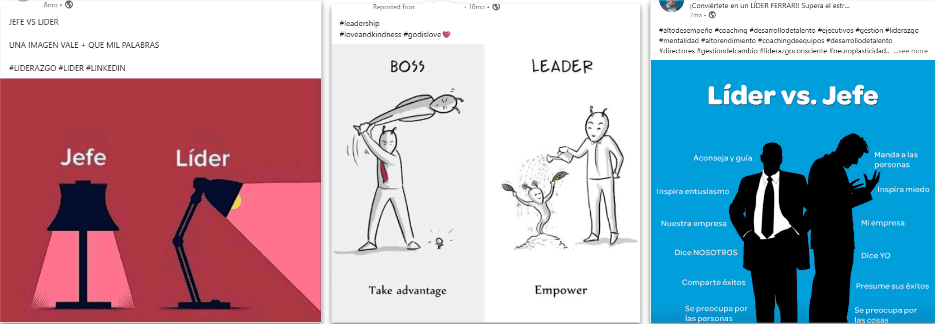
And here comes the simplistic, mediocre dichotomy: leaders are good and bosses are bad. Are all the leaders we know actually good? Do we not remember how millions of followers of Nazism ended up plunging the world into a second world war? Weren’t we witnesses to how some “well-known world leaders” openly faltered during the pandemic, right when humanity needed their help the most? Have we never had a good boss? I certainly have had both good and bad bosses. And I’ve followed both good and bad leaders.
In my opinion, the best thing is to be both boss and leader at once. Not only do you have followers, you also have the organizational, political, or military power (depending on the context) to make hard decisions.
Cheerleader Leadership
There’s a popular image of the leader as the person who lifts our spirits and pushes us forward when things get hard. A kind of cheerleader who boosts our mood when we’re demotivated. The reality is that leadership is much more than that. Leadership is profoundly varied and demands, from the leader, a huge capacity to absorb pressure and stress.
Being a boss also has its merits. Unlike leadership, being a boss isn’t easily delegable. While leadership can be shared and multiplied, nobody expects their boss to say one day, “I don’t feel like being the boss today, could you be the boss instead?” Being a boss is far more complex and, in many cases, carries responsibilities that go well beyond the assigned task.
And that’s where it all gets confused. The lines between being a boss and being a leader cross without anyone noticing. So, if I’m motivating people, I’m a great leader. But if the company hits a crisis and needs to cut staff to survive, I’m a boss when I have to let someone go. That’s, quite obviously, pretty silly.
Gender-based violence, religious violence, racism, xenophobia - so fashionable in our time - and discrimination are all built on the same principle: some are good, others are bad.
Leaders, Bosses, and Humans
To show how these roles and positions can sometimes coexist and clash, I want to share an anecdote that makes me proud as a person and conflicted as a boss.
Years ago I was leading a team - not too big, not too small. We trusted each other, we were close, confident in our abilities, we felt safe, even though the overall climate at the company was, frankly, terrible. I’d like to think that our team’s little microclimate was, in part, thanks to my leadership. We were a good team.
One day, one of the good ones, a solid member of the team, asked me for a private moment and told me, very personally, that he was seriously considering a strong job offer and might leave the company. Right there, two roles collide: the leader - close, a mentor, encouraging, keeping the energy up - and the boss, who has to look out for the interests of the team, the project, and the company.
My response: first, thank him for his trust, smile, and tell him that only he could judge whether it was truly a good opportunity; and second, tell him that from that moment on I had to consider him a risk to the project, and that I was obligated to start looking for a replacement, or at the very least, raise the alarm.
Conflict Between Leader and Boss
This is just one example, and I don’t mean to suggest it’s what you should always do. There are surely points for and against. And again, this was a particular circumstance within a context of leaders, followers, bosses, and subordinates. If you have thoughts - good or bad - I’d invite you to share them.
The conflict arose because my job as boss required putting the interests of the company and the project above the trust-based relationship with one member of the team. The trust that led to that conversation makes me proud as a leader, because it reflects the kind of leader I want to be - close, human, open.
Still, as a boss, it put me in a tough spot, exposing a real risk of losing one of the team’s key members. Do I play “the trusted mentor,” or “the manager who mitigates risk”?
How the Conflict Between Leaders and Bosses Played Out
This person left the team. It was almost inevitable, even before our conversation. And, I should note, we stayed in touch for years afterward. We both always valued not just the quality of our working relationship, but the honesty and transparency behind it. Maybe I gained a friend and lost a direct report.
We also mitigated the risk and managed a smooth, on-time handover of the role and responsibilities. The project barely felt the impact, and in the end, this person moved on to a better role - we never talked about how much better it actually turned out to be, or whether it was at all.
I made several mistakes. I’m sure of it. It worked out… THANK GOODNESS.
The Possible Contradictions Between Leaders and Bosses
The situation above shows clearly how leadership can sometimes clash with the obligation of being a boss. The boss, no matter what, has an obligation to address the risk of a possible departure. Far from being a hypothetical, this team member was seriously weighing an offer, seriously enough that he was already discussing it with his boss - and to be clear, I was only his direct manager, not someone from HR with resources at their disposal to counteroffer and reduce the risk.
The boss also has an obligation to follow procedure, if one exists - for example, contacting talent management, or HR as it’s called in many places, and reporting the incident or the flight risk.
The leader, for their part, can offer honest, transparent advice. Help weigh the pros and cons, and include, of course, the pros and cons of staying on the project. Side note: I think I already mentioned that the company in question was never, and as far as I know still isn’t, a very pleasant place to work.
Bosses Make the Hard Calls
Bosses make the hardest decisions, and they can’t delegate them. Leaders also make hard decisions, but in their role as leaders they can delegate that decision to other leaders, or even to their followers.
We’d love for a great leader to prioritize employee stability over the survival of the company. We love stories of great, humane leaders who sacrifice a company’s health to take care of their people. And it is admirable. But imagine a world where every leader punished the company’s health that way. Do you really think it would always work out? What happens if the company goes under and everyone loses their job? Things don’t always turn out fine, and the decision that looks most humane isn’t always the right one, in the end.
Remember, history is written by the winners, not the losers. How many humane bosses ran companies into the ground that we never even heard about? Impossible to say.
Good and Bad Leaders, Good and Bad Bosses
In these silly, divisive exercises, the premise is that only bosses get it wrong. Obviously, that’s FALSE. We have good bosses and good leaders, and we have bad bosses, and of course, bad leaders too.
A bad leader divides - divides because their power grows stronger through division. Can you think of examples in today’s politics of leaders whose strength and following are built on separating themselves from, or distancing themselves from, others? I imagine you can - the examples abound. Some literature calls this “the external enemy.”
I believe leadership, and the qualities that help leaders emerge and grow stronger, deserve real study and analysis. I believe future generations should be taught leadership skills, good communication, good interpretation, and critical thinking in school. I believe it so strongly that a few years ago I volunteered as a Community Liaison for a nonprofit whose mission, in part, was to strengthen leadership, communication, and teamwork skills in elementary and high school students.
Sometimes we assume leadership is only for extroverts with a gift for interacting and communicating, and we forget that even a withdrawn, quiet programmer like me can also build communication skills - and, I’d like to think, good leadership.
Bosses Who Are Leaders
The challenge isn’t to demonize bosses, but to make more and more bosses into better leaders. Being a boss isn’t trivial - even though, back when I was a programmer, I thought the boss’s only job was to walk around asking “how’s it going?”
There are, of course, plenty of bad bosses, because we’re terrible at telling the difference between doing and managing. But that doesn’t mean all bosses are bad and only leaders are good. There are great bosses who aren’t such great leaders, but who lean on the natural, fluid leadership of other people on their team to be excellent bosses. Again, leadership can be shared, multiplied, delegated.
What Do You Think of Bosses vs. Leaders?
I’d love for you to leave a comment on what you think of these “boss vs. leader” memes. Just to close out: years ago, at a conference, I once presented one of those “famous memes” and explained exactly what you just read. In short, that it’s nonsense. A few years later, someone copied and pasted the slide completely out of context and quoted me as the person who said bosses were bad and leaders were good. No comment.