How Do You Resolve Conflict on Your Team?
Table of contents
Let’s be honest, all of us, without exception, have had to deal with conflict at work and in our personal lives. It’s an inevitable part of social and professional dynamics. So why not learn to resolve conflict at work, and with the teams we interact with?
Part of a good project manager’s job is managing the unexpected. Funnily enough, we never expect a conflict - though I know a few people who show up at the office as if they wanted to “start a war” XD.
This article talks about conflict on teams and the importance of recognizing conflict as something natural, inherent to interpersonal relationships. That should help lower the temperature, take the discussion out of the personal realm, and resolve conflicts that, however unpleasant they may seem, are part of what we are: human.
What Is Conflict?
The word comes from the Latin conflictus. It’s made up of the prefix con- (convergence, union) and the verb fligere (to strike or afflict). In other words, in etymological terms, conflict means something like “a clash of several.”
Conflict, then, speaks of a confrontation between multiple parties - there must be more than one for conflict to exist - though I admit I sometimes fight with myself alone.
As I said, this article focuses on techniques for resolving workplace or organizational conflict. Don’t expect to find advice on improving your relationship with your partner here. Still, I have no doubt you’ll find each of the nine tips below useful for resolving organizational conflict.
Why Does Conflict Arise in Organizations?
First and foremost, you need to understand that problems, arguments, and conflict in general are a natural part of social - and therefore professional - dynamics. Conflicts are as natural and human as breathing, a heartbeat, or communicating.
Conflicts always arise from divergence between people - their opinions, their actions, or their way of thinking. So we can classify them by “reach” and the magnitude of that divergence as:
- Internal
- External
And
- Personal
- Group-level
- Organizational
That’s how we end up with intrapersonal conflicts - a person’s own internal contradictions[ref]Intrapersonal conflict might seem to contradict the concept of conflict, which assumes at least two people. But a person with internal contradictions is prone to conflict with others. What matters, as managers and leaders, is identifying this category and helping these people find a resolution to their contradictions - work that can draw on mentoring or coaching techniques.[/ref]; interpersonal conflicts - opposition or differences between two or more people; intragroup and intergroup conflicts; and, of course, intraorganizational ones.
In every case, what matters most, and what our work as leaders or as a team should focus on, isn’t the conflict itself, but how we manage it.
Managing and Resolving Disputes
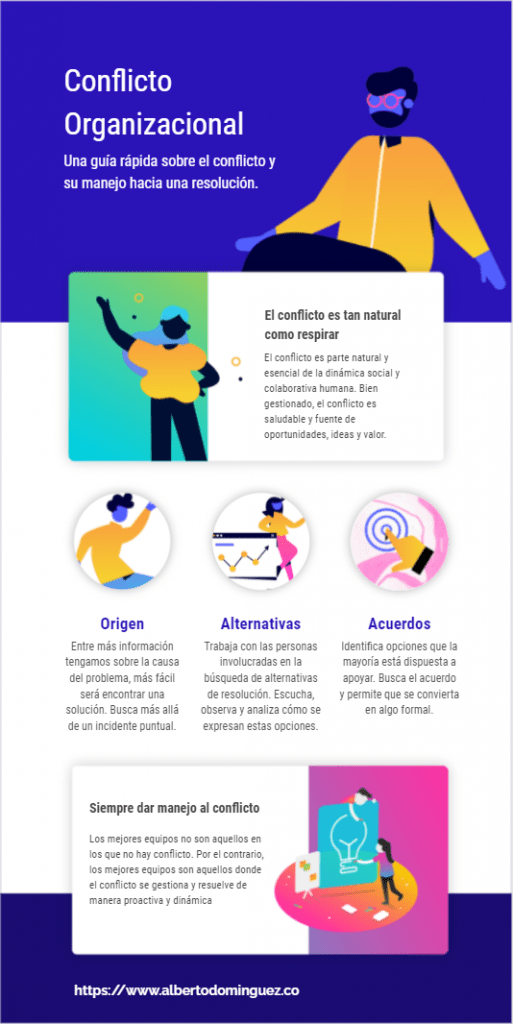
Original infographic made with Genial.ly
Avoiding conflict is, almost always, a mistake. Conflict shouldn’t be avoided - nor should it be encouraged. Still, ignoring or avoiding it leads to a buildup of pressure and stress. In Colombia - my country - we have an expression: “calma chicha .” We use it to describe how, despite there being plenty of arguments or reasons for concern, everything seems calm on the surface. A maddening, unsettling, stressful kind of calm.
One of the five team dysfunctions described by Patrick Lencioni is “fear of conflict.” This usually reflects a lack of trust among team members to speak openly about problems and challenges. And that keeps the team from seeking resolution to conflicts that, I’ll say it again, are natural to team dynamics.
Hence the importance of managing conflict - giving it the healthy, necessary space for team members to talk, discuss, and seek resolution.
Five Key Steps to Resolving Conflict

Conflict management runs both wide and deep. This short sequence of steps is useful for structuring a more complex, deeper process. I’m confident it can be a solid starting point for you and your teams.
Step 1: Identify the Root of the Problem
The more information your team has about the cause or origin of the problem, the easier it will be to identify alternatives for resolving it. To gather the information you need, it’s worth running activities aimed at exactly that - for example, meeting privately with each party involved, looking for useful information from “their point of view,” and then, if conditions allow, reviewing the information with the whole team, in order to keep the conflict “within the team” or the “parties involved.”
If you’re in the role of leader, facilitator, or manager, you need to make sure every party involved gets the chance to tell their side, share their perspective, and be heard. If you’re part of the conflict - and not a mediator - seek out a mediator’s support.
Step 2: Classify and Structure the Information About the Conflict
Ask powerful questions aimed at sorting the information into feelings, thoughts, emotions, events, and actions. You need to avoid letting the information narrow down to a single specific event - what we often call an incident. Conflicts have an origin (an initial incident) and other events that have deepened or worsened the situation over time.
Try to build a timeline, and connect that timeline to the feelings and emotions involved. Emotions are reactions that happen spontaneously and automatically. That’s why what we call an “emotional hijacking” often happens, where our behavior isn’t driven by reason but by emotion. That’s also why the “incidents” or events within a conflict can be driven by stress, anger, or rage, rather than by our thoughts, ideas, or feelings.
Step 3: Ask For, or Propose, Solutions to the Conflict
Expressing our own perspective is “the easy task.” Building a team, on the other hand, is hard work and can take a significant amount of your own energy. So don’t limit your participation to active listening - encourage the search for solutions. If you’re a facilitator, it’s simpler: just ask for solutions or alternatives.
When you’re part of the conflict, proposing solutions requires a “cool head” and analysis. So keeping your emotions in check is a fundamental part of the process of resolving conflict.
Step 4: Identify Solutions Everyone Is Willing to Support
Look for solutions and identify what’s valuable in each alternative. What does it bring to the table? What’s the benefit of this alternative? What’s the cost, or the downside? The goal isn’t to land on a solution that thrills everyone involved - that would be ideal. The goal is to land on a solution everyone is “willing to support.” Resolving conflict isn’t always a light, easy process - it takes effort, dedication, and daily commitment.
Step 5: Reach an Agreement
This seems obvious, and yet, it’s striking how often, for many teams, the discussions and proposals never actually lead anywhere.
A few days ago, someone asked me “what do we do with what comes out of retrospective meetings?” At first, I didn’t understand the question, and then I realized: the team wasn’t taking action or making decisions on the information analyzed and discussed during the retrospective.
Presumably - and I admit I don’t know the details of that particular team’s situation - the team was trying to make decisions or take action on things that were outside their control.
What Does It Take to Resolve Problems?
The same applies to conflict: we need to act on what we can and should manage, not on things beyond our control. If the conflict has a solution, why worry? If the conflict has no solution, why worry?
- We need patience and dedication to work toward a resolution.
- We need the wisdom to recognize and accept the things that have no solution.
Effective Techniques for Resolving Conflict
If what you need is patience and dedication, using the right tools at the right moment can save you a lot of stress and a lot of emotional hijacking. Remember, mediators are human too, and just as sensitive to their environment. If you have more ideas or suggestions, don’t hesitate to write them in the comments - I’ll gladly update the list.
1. Keep Conflicts Within Their Boundaries
Conflicts happen within certain “boundaries.” So always try to keep the problem inside those boundaries. If the conflict is intrapersonal, support that person in private. Avoid exposing their conflicts to other people - that could break the trust and the work you’ve built.
Escalating a problem beyond these boundaries is always an option, but if used too early, it can send the opposite message: “that problems don’t stay within the team, and everything gets exposed before it’s even discussed.” That can break trust within the group.
2. Find the Most Suitable Space to Discuss It
Just as important as keeping the problem within its own context is finding the most suitable space for key conversations. In my opinion, nothing beats a neutral space for a face-to-face conversation. If that’s not possible, always reach for the richest channel available to you.
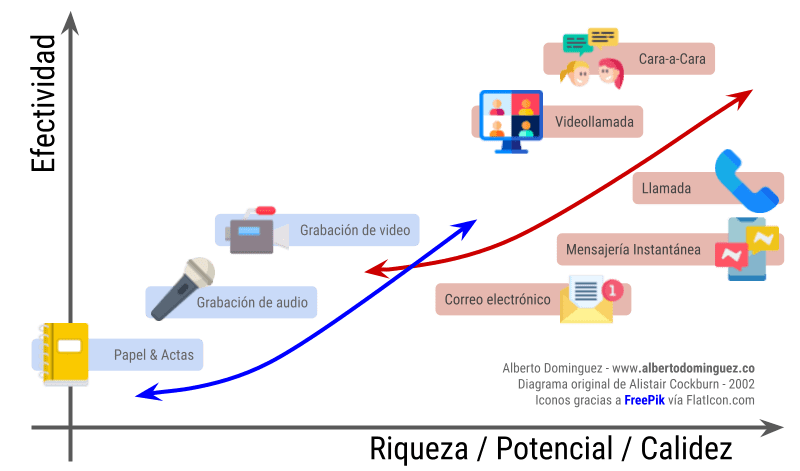
As you can see, choosing a good channel will support the conversation with the parties involved in the conflict. If you want to read more about communication channels, I’d invite you to read an excellent article published on AgileModeling .
3. Act with Pause and Calm
The most common mistake in conversations and debates is failing to give weight to the pause - the moment to reflect before you speak. Sometimes, staying silent is the best thing you can do.
Encourage analysis and interpretation. Listen before you speak.
Choose your words. Choose your actions. If you’re part of the conflict, avoid at all costs the amygdala hijack - which all of us have fallen victim to.
4. Separate the Problem from the People
Whenever possible, identify the problem as a divergence of opinions. Avoid slipping into a conflict aimed at the person and their “being.” Look for interests, not “perceptions.” We often attach a feeling - or an emotion, which is temporary and more intense - to a person.
For example, Latin Americans near the Caribbean are known worldwide for their warmth and cheerfulness. But a dark side of those very qualities is the difficulty in building professional relationships that aren’t expected to become friendships.
In that sense, some people struggle to build good relationships with “coworkers” they couldn’t imagine being friends with. We confuse camaraderie with friendship, teamwork with “working among friends.”
This makes conflicts prone to quickly turning into personal problems.
5. Don’t Generalize Your Opinion
Opinions are, precisely, that: one person’s subjective view. Avoid generalizing and using words like “always” or “everyone.” If it’s your opinion, don’t try to make it look “objective.” Accept the weakness of your own subjectivity, and use expressions like “I feel,” “I think,” or “my perception is.” Avoid pointing at others with phrases like “you always” or “everyone says.” For example, instead of saying:
“Why did you say…?”
Try saying instead:
“When I heard your words, I felt…”
This avoids finger-pointing and puts the focus on feelings, emotions, and your own response to the situation.
6. Sometimes One Session Isn’t Enough
Give people enough space to process their emotions. Don’t force yourself, or the team, to resolve every conflict in a single sitting. Sometimes it’s better to wait. You need to understand that not everyone is ready, and some are still caught up in their emotions. Not everyone processes emotions the same way, or at the same speed.
When, during a joint session, things start to spiral out of control, take a time-out. Minutes, or days. Help both parties reflect.
7. Follow Up and Confirm the Decisions
Finally, don’t leave things to chance. Don’t assume solutions will materialize on their own. After sessions aimed at resolving conflict, it’s wise to follow up and show genuine interest in moving toward consolidating the solution.
Often, resolution sessions turn into spaces for “venting.” This happens when people know it’s the only moment they’ll be heard, and that nothing will happen afterward. Over time, this only deepens the conflict.
The Project Manager’s Role in Resolving Conflict
The project manager is, of course, the person called on to stay calm and, as much as possible, refrain from getting directly involved in the conflict. In other words, the manager needs to stay neutral - as much as possible - to be able to play a good mediating role.
Mediation - or arbitration - during the search for solutions to conflict requires objectivity and neutrality. Otherwise, it will only sharpen the conflict, since it implies greater resistance or difficulty for one of the parties.
Would You Like to Share Your Thoughts?
I’d invite you to share your opinions and experiences about conflict within organizations. Please avoid calling out specific people or companies. What matters is reflecting on the resolution you found, or the one you wish you’d found.